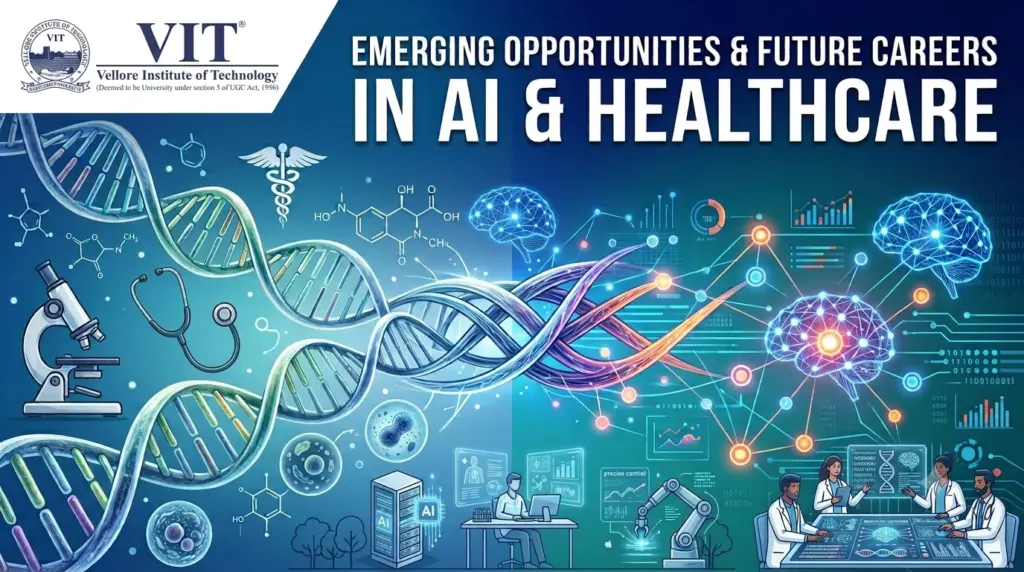
Not every healthcare career requires an MBBS degree. With artificial intelligence transforming medicine, students can pursue non-clinical pathways in data science, informatics, bioinformatics, engineering, and research to solve real-world healthcare problems. Whether you want to discover new medicines using machine learning, build software that analyzes genomic sequences, or design algorithms to detect diseases in medical images, AI in healthcare opens up high-impact career pathways for tech-minded students.
What Is AI in Healthcare?
AI in healthcare refers to using artificial intelligence and digital tools to analyze health data, support clinical decision-making, and streamline biomedical research. The World Health Organization also highlights the importance of responsible development and use of AI in health (see WHO guidance on AI in healthcare).
How Is AI Used in Healthcare?
Modern healthcare systems use data pipelines, automated tools, and computational models to process patient records, analyze molecular interactions, and support medical-device applications. AI in biomedical research initiatives also highlight the growing use of AI and machine learning across biomedical data and research. Applications can include medical imaging, clinical decision support, health data analysis, genomic research, hospital operations, and medical-device development. Note that AI functions as a supportive tool across healthcare disciplines, and not every role in this field requires building or training complex AI models from scratch.
AI in Healthcare Careers and Jobs
AI in healthcare is creating career opportunities across healthcare data, clinical informatics, bioinformatics, medical technology, computational biology, digital health, and drug discovery. The right career path depends on whether you are more interested in computing, biology, healthcare systems, engineering, or research. AI is one part of these careers, not always the entire job. Some professionals build AI models, while others use AI alongside programming, biology, healthcare data, or research.
| Career | What You’ll Do |
| Health Data Scientist | Analyse healthcare data and build predictive models. |
| Healthcare Data Analyst | Query healthcare data, build dashboards, and report insights. |
| Bioinformatics Scientist | Analyse genomic and biological data using computational tools. |
| Healthcare AI/ML Engineer | Build and deploy AI/ML systems for healthcare applications. |
| Clinical Informatics Specialist | Improve how clinical teams use healthcare information systems. |
| Computational Biology Researcher | Use computational models to study biological systems. |
| AI Drug Discovery Researcher | Use computational methods to study molecules and drug candidates. |
| Digital Health Product Manager | Plan digital health products and coordinate development. |
Typical Pathways and Environments for These Careers
To help you understand the academic backgrounds, key skills, and work environments for these roles:
- Data roles: Data Science, Computer Science, or Health Informatics background. Common skills include Python, SQL, statistics, and machine learning.
- Bioinformatics and computational biology: Bioinformatics, Computational Biology, or Biotechnology background. Common skills include genomics, biological data analysis, and Python/R.
- AI/ML engineering: Computer Science, AI, or Software Engineering background. Focus on software engineering, machine learning, and deployment.
- Clinical informatics: Health Informatics, Computer Science, or Health Sciences background. Focus on EHRs, healthcare data standards, and clinical workflows.
- AI drug discovery: Bioinformatics, Biotechnology, or AI background. Focus on molecular modeling, machine learning, chemistry, and biology.
- Digital health product management: Computer Science, Health Sciences, or Management background. Focus on product development, healthcare technology, and user needs.
Which AI Healthcare Career Is Right for You?
Choosing the right role depends on your specific interests and what you enjoy doing day-to-day:
- If you enjoy mathematics, statistics, and coding:
Health Data Science may suit you because you’ll work with healthcare datasets and build predictive models to analyze patient trends. - If you enjoy biology but also want to code:
Bioinformatics could be a good fit because you’ll work with genomic and biological data, helping researchers understand complex diseases at a molecular level. - If you prefer healthcare systems and digital tools:
Clinical Informatics is worth exploring. You’ll bridge the gap between medical workflows and digital health records to improve hospital systems and patient care. - If you love core software development and AI engineering:
Healthcare AI/ML Engineering is a good fit if you enjoy building and deploying AI models and software applications used in healthcare. - If you are passionate about biological research and scientific discovery:
Computational Biology allows you to use computer models and simulations to study biological systems and investigate complex biological or medical questions. - If you are fascinated by chemistry, drug research, and AI:
AI Drug Discovery could be a good fit if you are interested in chemistry, drug research, and machine learning. You may use computational models to study molecules and help researchers evaluate potential drug candidates.
Remember, you don’t have to decide everything right now. If you’re still unsure which path fits, start with the subjects you enjoy most. Students who enjoy coding and mathematics may lean toward data science or AI engineering; those who enjoy biology and coding may prefer bioinformatics; and if you’re interested in healthcare systems, health informatics may be a better match.
What Degree Do You Need for an AI Healthcare Career?
The right degree depends on what you want to work on. If you enjoy coding, you may prefer computer science or bioinformatics. If you are interested in healthcare systems, health informatics may be a better fit. Here is a simple guide to matching your academic path with your goals:
- Want to build AI systems and healthcare software? → Computer Science / Software Engineering
- Want to work with genomic data and biological systems? → CSE (Bioinformatics)
- Want to improve hospital workflows and clinical records? → CSE (Health Informatics)
- Want to develop biomedical devices and technology? → Bioengineering
- Want to focus on laboratory science and biological research? → Biotechnology
- Want to apply technology across clinical and health applications? → Health Sciences and Technology
- Want to combine advanced AI with molecular research and drug discovery? → Integrated M.Tech. AI and Bioinformatics
AI Healthcare Fields: Understanding the Differences
These fields overlap, but they work with different types of problems and data. Bioinformatics focuses on biological and genomic data, while health informatics focuses on healthcare systems and patient information. Computational biology uses computer models to study biology, while AI drug discovery applies AI to pharmaceutical research.
| Field | Main focus | Typical data |
| Health Data Science | Healthcare analytics and prediction | Patient and operational data |
| Bioinformatics | Biological and genomic analysis | DNA, RNA, and genomic data |
| Health Informatics | Healthcare information systems | EHRs and clinical data |
| Computational Biology | Modeling biological systems | Biological and molecular data |
| AI Drug Discovery | AI-assisted pharmaceutical research | Molecular and chemical data |
Essential Skills for AI Healthcare Careers
Working effectively in healthcare technology requires proficiency across technical, biological, and domain-specific knowledge areas.
- Technical skills: Help professionals build, analyse, and maintain AI and data systems.
- Life-science knowledge: Helps them understand the biological problems the technology is being used to solve.
- Healthcare-specific knowledge: Helps them work with clinical information, healthcare workflows, privacy, and regulatory requirements.
You do not need every skill listed here for every career. The skills you need depend on the role and degree pathway you choose.
Technical Skills
- Python programming and relevant libraries: Used to analyse data, build machine learning models, and automate processes.
- Statistics and probability: Help you understand whether patterns in healthcare data are meaningful and whether a model is making reliable predictions.
- Machine learning principles and algorithm design: Used to build models that can classify data or make future predictions (like recognizing patterns in medical scans).
- Data cleaning and analysis: Crucial because real-world healthcare data is often messy, and you need to prepare it properly before feeding it into any AI model.
- Databases and SQL: Help you query and organize large, structured datasets stored in hospital or research databases.
- Bioinformatics tools: Software and databases specifically designed to analyse genomic sequences and biological patterns.
- Data visualization: Creating charts and dashboards (using tools like Tableau or Streamlit) so clinicians and researchers can easily understand your findings.
Life-science Knowledge
- General biology: The foundational concepts of how living organisms work.
- Genetics and genomics: Crucial for understanding DNA sequences and running bioinformatics analysis.
- Molecular biology: Focuses on processes inside cells, which is vital for designing new drugs.
- Human physiology and anatomy: Helps you understand the medical context behind the data you analyse.
Healthcare-specific Knowledge
- Health information systems: Understanding how clinical data is stored, organized, and retrieved in real-world hospitals.
- Clinical data standards (like HL7 or FHIR): The “languages” and formats used to ensure different hospital software systems can safely exchange patient data.
- Medical terminology: Knowing the terms doctors use so you can accurately analyse clinical notes and health records.
- Data privacy and ethics (like HIPAA): The strict regulations and rules that govern how sensitive patient information must be handled to protect privacy.
Professional Skills
Beyond technical and biological expertise, working in AI healthcare requires non-technical capabilities to work safely and collaboratively.
- Analytical and problem-solving skills
- Scientific communication
- Collaboration with healthcare and research teams
- Critical thinking
- Understanding of responsible AI and data ethics
- Adaptability and continuous learning: AI and healthcare technology change quickly, so professionals need to keep learning tools, regulations, and methods.
How to Start a Career in AI and Healthcare
- Build a strong foundation in key subjects like mathematics, biology, computer science, or statistics.
- Choose a degree aligned with your interests.
- Learn Python, statistics, and data analysis.
- Build healthcare or biological data projects using public datasets. Beginner educational project ideas include:
- Analysing a public health dataset (e.g., CDC or Kaggle diabetes data) to identify key risk factors.
- Building an educational disease-risk prediction model using Python and Scikit-Learn to learn classification and model evaluation.
- Creating a genomic sequence alignment tool using Python and Biopython.
- Designing an interactive clinical data dashboard using Tableau, PowerBI, or Streamlit.
- Develop a student portfolio to showcase your technical growth. Tip: You do not need a large portfolio. Two or three well-explained, complete projects are far better than ten unfinished ones. A strong portfolio should include:
- A GitHub repository containing clean, documented Python/SQL code for your projects.
- Clear README summaries explaining the problem, dataset, tools used, and key findings.
- Visual outputs such as plots, dashboards, or live project demonstrations.
- Learn about healthcare systems, privacy, and ethics.
- Gain research, internship, or project experience.
Where Can AI Healthcare Professionals Work?
Graduates in this field find opportunities across several industries, including:
- Hospitals and healthcare networks
- Pharmaceutical companies
- Biotechnology companies
- Medical-device companies
- Digital health companies and health-tech startups
- Healthcare technology and software companies
- Research institutions and universities
- Clinical research organisations
- Government and public-health organisations
Career paths across these settings differ based on specialization: some focus on technical roles like data science and engineering, while others specialize in clinical informatics, product management, or research.
VIT Programme Options for AI and Healthcare Careers
There isn’t one “best” VIT programme for AI in healthcare. The right choice depends on whether you want to work mainly with biological data, healthcare systems, medical devices, biotechnology, or AI-driven research. Here is how VIT’s degree programmes match different interests:
| Programme | Best For |
| Bioengineering | Biomedical devices, diagnostics, biomechanics |
| Biotechnology | Biotechnology, biological research, life sciences |
| CSE (Bioinformatics) | Programming + genomics and biological data |
| CSE (Health Informatics) | Healthcare data and clinical information systems |
| Health Sciences and Technology | Healthcare technology and medical applications |
| Integrated M.Tech. AI and Bioinformatics | AI, genomics, computational biology, drug discovery |
Frequently Asked Questions
No. Non-clinical careers in healthcare data analysis, biological software development, medical device engineering, and computational drug discovery can be entered through degrees in engineering, computer science, biotechnology, bioinformatics, or health informatics, depending on the role.
The subjects you need depend on the programme and its admission requirements. Biology and Chemistry are important for life-science pathways, while Mathematics and Computer Science can be particularly useful for computing, data, and AI-focused programmes. Students should check the eligibility requirements for their preferred VIT programme before applying.
Eligible PCB students can apply to certain VIT B.Tech programmes, subject to the programme-specific eligibility requirements and admission category. VIT’s current published eligibility information lists specific programmes for PCB candidates. VIT currently lists Biotechnology, CSE (Bioinformatics), Health Sciences and Technology, Bioengineering, and CSE (Health Informatics) among the programmes available to eligible PCB candidates. Check the latest admission requirements here.
The best degree depends on the type of healthcare problem you want to work on. Common pathways include computer science, bioinformatics, health informatics, bioengineering, biotechnology, health sciences, and AI and bioinformatics.
Roles can include Health Data Scientist, Healthcare Data Analyst, Bioinformatics Scientist, Healthcare AI/ML Engineer, Clinical Informatics Specialist, Computational Biology Researcher, and AI Drug Discovery Researcher.
AI healthcare careers require a mix of technical skills (programming, machine learning, data visualization), life-science knowledge, healthcare domain understanding, and soft skills like problem-solving and collaboration.
Start by building a foundation in math, biology, or CS, choosing an aligned degree, learning Python and data analysis, and gaining practical research or project experience.
AI in healthcare can be a strong career option for students interested in combining technology with biology, medicine, data or research. Opportunities span healthcare analytics, bioinformatics, clinical informatics, medical technology, digital health and computational drug discovery. Career prospects depend on the role, degree, technical skills and practical experience.
Bioinformatics uses computing to analyze biological and genomic data, whereas health informatics focuses on healthcare information systems, clinical data, and digital health workflows.
AI can help healthcare professionals analyse large datasets, identify patterns in medical information, support diagnostic workflows, and accelerate research such as drug discovery. It is generally used as a decision-support and research tool, with human professionals remaining responsible for clinical judgement and patient care.
Conclusion
AI in healthcare offers career paths for students interested in technology, biology, data, engineering, and research. The right degree depends on the type of healthcare problem you want to solve and the skills you want to develop. Explore the relevant VIT programme options and compare their curriculum, eligibility requirements, and career pathways before making your choice.
- Biology + computing → Bioinformatics
- Healthcare data + digital systems → Health Informatics
- AI + biological data → AI and Bioinformatics
- Engineering + medical devices → Bioengineering
- Biotechnology + laboratory science → Biotechnology
Ready to start your journey? Visit the official VIT Programmes Offered page to explore programme options, review eligibility requirements, and compare the pathways that match your interests before applying. Students interested in biotechnology and biological research can also explore VIT’s School of Bio Sciences and Technology (SBST) and School of Healthcare Science and Engineering (SHINE).